Jul 13, 2026
Reflections from UIA 2026 Barcelona
The UIA 2026 World Congress of Architects in Barcelona brought together architects, thinkers, and designers to reflect on a profession in transition. Organized by the International Union of Architects, the Higher Council of the Orders of Architects of Spain, and the Architects’ Association of Catalonia, the Congress was supported by the Ministry of Housing and Urban Agenda of Spain, the Government of Catalonia, and Barcelona City Council.
It was called “Architectures for a planet in transition.”
Structured around six thematic lines — Becoming More-than-human, Becoming Circular, Becoming Embodied, Becoming Interdependent, Becoming Hyper-conscious, and Becoming Attuned. Across the talks, one question kept returning: what does it mean to be an architect now, in a time shaped by artificial intelligence, media saturation, ecological urgency, and social instability?
In the session “Digital Intelligence,” Areti Markopoulou, President of IAAC, offered a generous but urgent observation: in the age of AI, “our ways of collaboration need to expand.” Rather than seeing intelligence as something contained within a single designer, tool, or discipline, she suggested that architecture must become more open, more networked, and more capable of working across different forms of knowledge.
Mario Carpo expressed skepticism. He warned that much of today’s AI conversation is driven by hype, exaggeration, and commercial pressure. “It is a product they have to sell,” he argued, describing generative AI as part of a financial bubble. For Carpo, AI may generate images and patterns, but it still cannot truly make decisions, much less design. His message was not anti-technology, but anti-naivety: understand the tools without surrendering judgment to them.
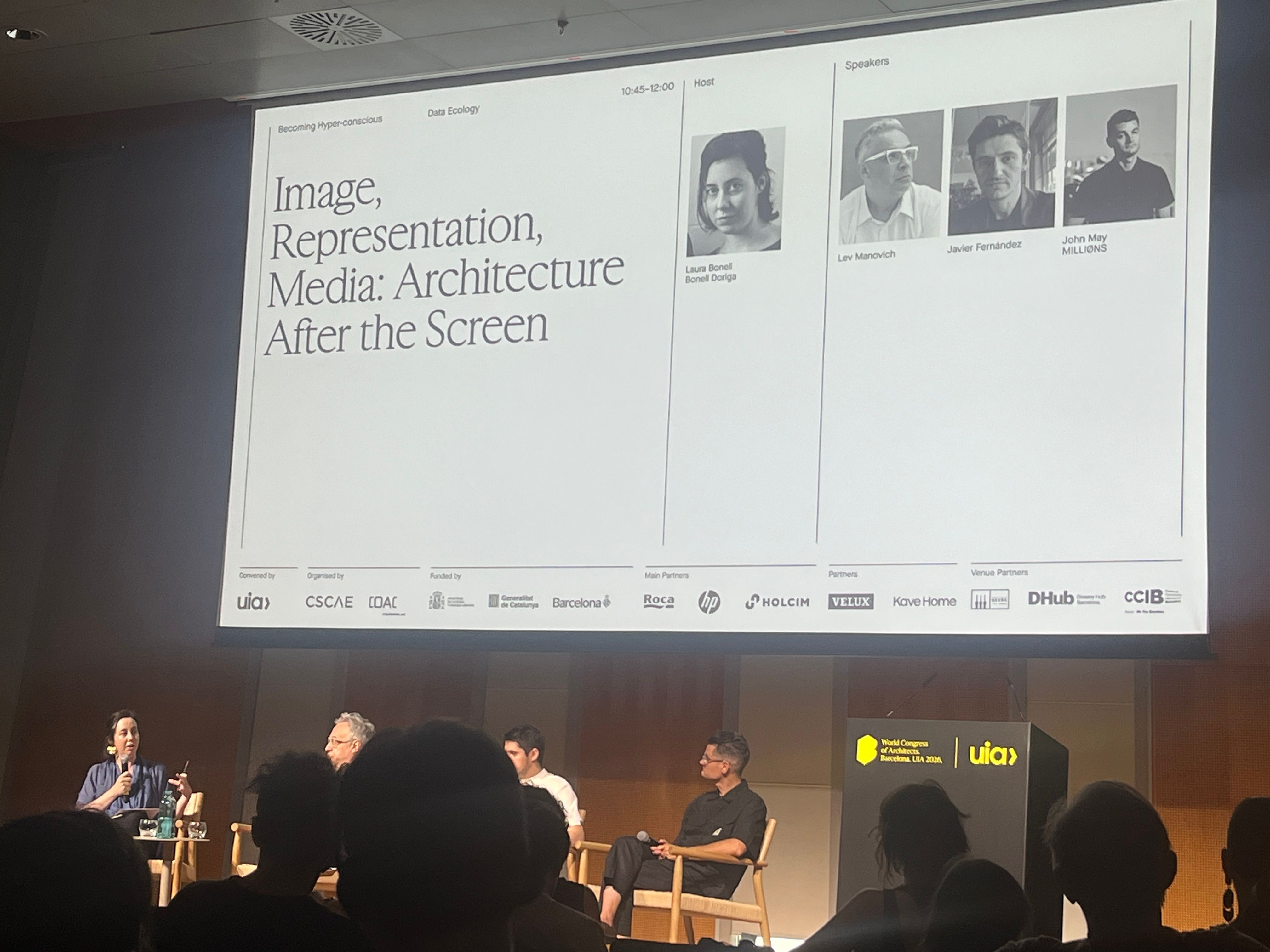
That theme continued in “Image, Representation, Media: Architecture After the Screen,” with Lev Manovich, Javier Fernández Contreras, and John May of MILLIØNS. One phrase stayed with me: “The time of our thought is our thought.” Suggesting that architecture is not only about outputs or polished representations, but that the duration of thinking, the iteration and process, is itself part of the work.
Lluís Nacenta, President of DHub, echoed this idea through a contrast of architects and AI. Noting that architects are not specialists in the narrow sense in that they move between disciplines, materials, and people. In contrast, AI by default is a highly specialized machine. It can be fast and convincing, but it is also superficial to the extent that it does not care about the process or effect. Architecture cannot afford that luxury. To design is to care about how something is made, why it exists, who it serves, and what consequences it creates.
In “Radical Ecologies: Architecture as Political Engagement,” Petra Blaisse discussed the overlooked intelligence of the natural world, bringing unexpected attention to something as humble as worms. Her point opened a different way of thinking about architecture: not as an isolated object, but as part of living systems. Ecology here was not a decorative theme, but a political and material focus.
Finally, Shigeru Ban’s lecture “Material as Time: Structure, Economy, and Emergency Architecture” offered humor and clarity as he walked through a career built around paper tubes, temporary emergency structures, and low-cost material intelligence. His work challenges the assumption that permanence comes only from expensive or grand construction. Sometimes the “temporary” structure becomes the most lasting one. Not because it stands forever, but because of its efficient and economical response to an urgent need. Looking back, we see that these talks show that architecture is entering a moment of profound reassessment. AI may change the tools and screens may change representation, and ecological and emergency cases may change priorities, but the architect’s role remains rooted in responsibility, collaboration, and care.The future of architecture may not belong to those who produce the fastest image, but to those who can still ask the deeper questions: what is this for, and what does it leave behind?